Tag: cinema

  • Gladiator 2: Power, Corruption, and Virtue (Movie Review)

    Gladiator 2: Power, Corruption, and Virtue (Movie Review)

    First Francis Ford Coppola, now Ridley Scott. This year’s second film set in the Roman era is Gladiator 2, and this is certainly no coincidence. Could it be, as has often been said, that the United States is the 21st-century version of the Roman Empire? Just today, Elon Musk, the prospective Minister of Efficiency of the new U.S. government, reiterated this cliché on his own social media platform. Could these films be telling us the same story in different ways? Let’s take a closer look—starting with the background.

    With every sequel or reboot, the question is always the same: will it be as good as the original?

    2024 is the year of reboots and sequels: Mad Max, Dune, Joker, Beetlejuice, Mean Girls, The Lion King, Planet of the Apes, Godzilla, King Kong, Deadpool, Transformers, Venom… and now, the much-anticipated Gladiator has joined the list. With every sequel or reboot, the question is always the same: will it be as good as the original? It could be argued that some of this year’s sequels, like Dune 2, Mad Max: Furiosa, or Deadpool & Wolverine, have approached or even surpassed the success of their originals or predecessors. I’m confident we’ll see Dune 2 feature prominently during awards season, claiming accolades wherever it has the chance. Similarly, Mad Max: Furiosa might also find moments to shine. For Gladiator 2, a film perhaps even more iconic than Mad Max in cultural status, the question was no different: could Ridley Scott, after all these years, craft a sequel worthy of the legendary 2000 film, with its unforgettable lines, iconic scenes, and intergenerational legacy?

    Excitement only grew as Connie Nielsen returned to the cast alongside Denzel Washington and rising stars Paul Mescal and Pedro Pascal. Yet in recent weeks, the reviews and commentary suggested that the film fell short of expectations. We watched and saw for ourselves. Either I was too captivated by the film’s charm, or the recent critics had a different perspective.
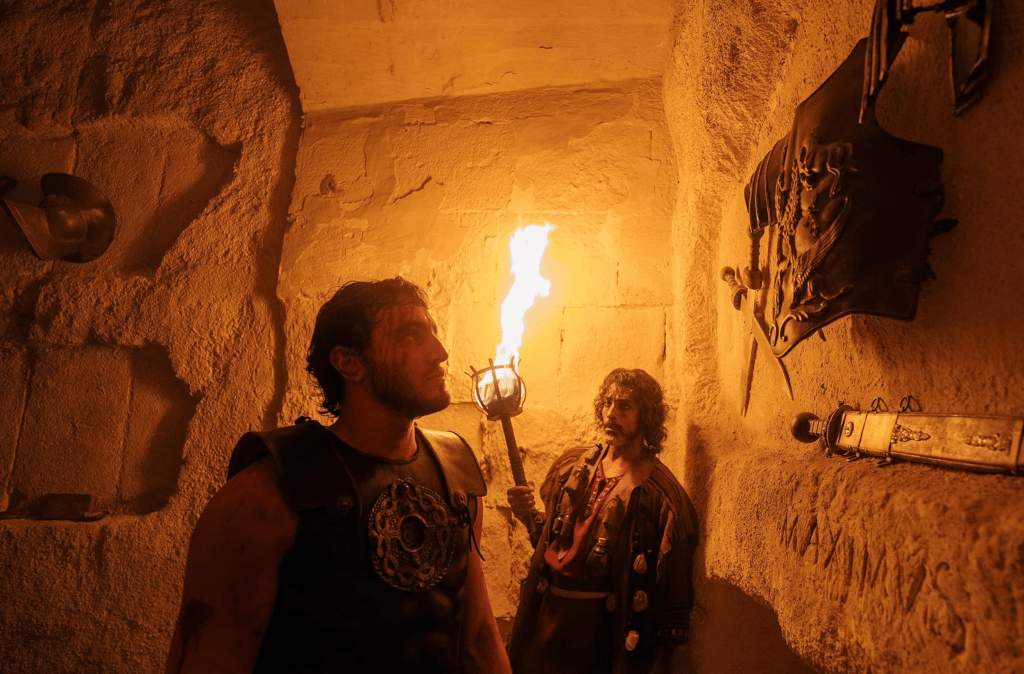
    Gladiator 2 (2024) | Dir. Ridley Scott

    The story takes place 15 years after the deaths of emperors Marcus Aurelius (Richard Harris), his successor Commodus (Joaquin Phoenix), and our immortalized hero Maximus (Russell Crowe) from the first film. This time, the focus shifts to Lucius (Paul Mescal), Maximus’s Roman heir. Caught in the grip of a deeply corrupt Roman Empire, Lucius finds his fate mirroring that of his father, as he is inevitably drawn into the gladiatorial arena. The film excels in many aspects, particularly the war scenes at the beginning and the Colosseum battles, which now even include naval combat. Its production design and set decoration are likely to draw significant attention. Now, back to the plot…

    The heir to Rome, Lucius, utterly despises the Empire and its rulers, whose depravity has veered far from the path once envisioned by his grandfather. Naturally, his presence attracts the attention of certain scheming individuals who thrive on manipulation. This is where Macrinus (Denzel Washington) enters the scene—a complex character with shades of an anti-hero, a sort of gladiator trader. While he elevates Lucius’s stature within Rome and the imperial court, he simultaneously plots the downfall of emperors and rivals alike. Washington’s portrayal of Macrinus is compelling, and his career and acting prowess need no introduction. However, it’s no coincidence that he was offered this role, as it closely resembles a character he played just three years ago. In Joel Coen’s 2021 adaptation of Shakespeare’s The Tragedy of Macbeth, Washington portrayed the ambitious and cunning Macbeth. It seems almost certain that Scott cast Washington after watching that performance. In Gladiator 2, as Macrinus, Washington delivers a similar performance as a schemer chasing power with ‘Macbeth-like’ precision.
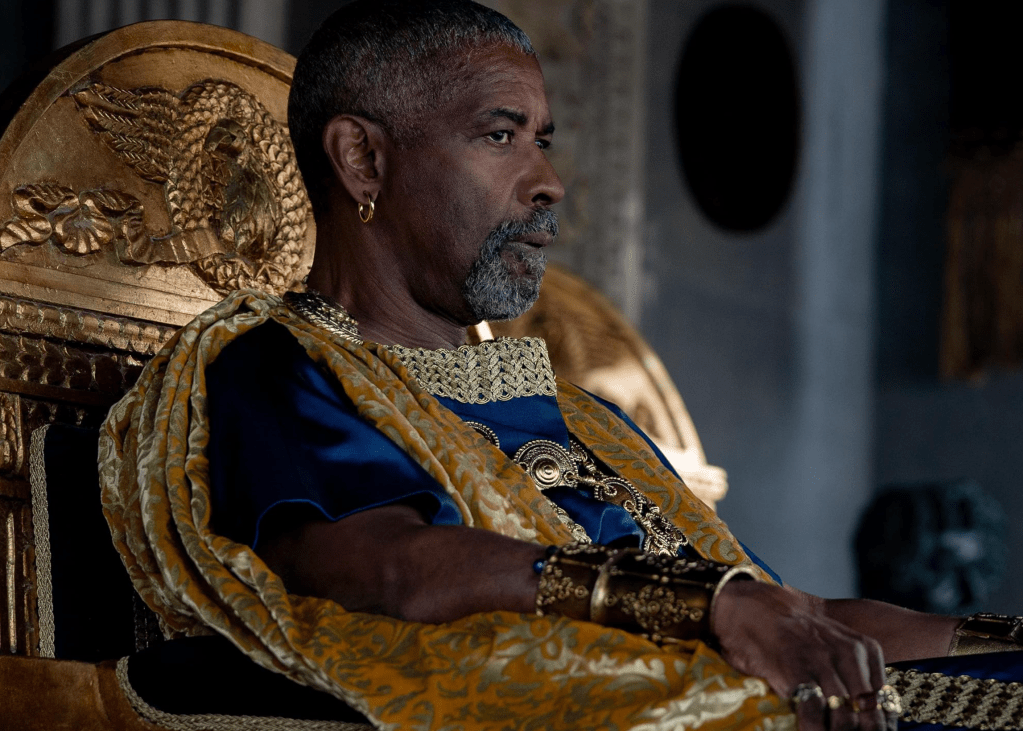
    Gladiator 2 (2024) | Dir. Ridley Scott

    “Justice is the will of the stronger.”

    Macrinus embodies a concrete philosophical school of thought, which he unabashedly voices in the film. His worldview draws from Thrasymachus, the sophist prominently featured in Plato’s Republic, who argued, “Justice is nothing else other than the will of the stronger.” Without explicitly naming Thrasymachus, Macrinus directly articulates this perspective as his manifesto multiple times. Historically, Macrinus could indeed have been aware of Thrasymachus and Plato, considering that Marcus Aurelius himself taken inspiration from Plato. However, the film does not establish this connection. Still, a clear ideological conflict emerges. On one side are the virtuous governance ideals represented by Plato and Marcus Aurelius, rejected outright by Macrinus, and on the other side is Macrinus himself, embodying Thrasymachus’s disdain for virtue and faith in raw power. Observing this ideological framework, it becomes clear that Macrinus is Scott’s intended antagonist.

    However, Scott chooses to reveal Macrinus’s schemes and ambitions only toward the film’s final act. Until then, the audience is preoccupied with the decadence and capriciousness of emperors painted as the villains—albeit not very convincingly. This perceived lack of a strong antagonist until the last act might have been a deliberate choice. The film meticulously pays homage to the original without altering or disrespecting any details, and this ambiguity around the antagonists may have been intentional. Furthermore, Gladiator 2 shares a thematic connection with Francis Ford Coppola’s Megalopolis, developed over decades by Coppola.
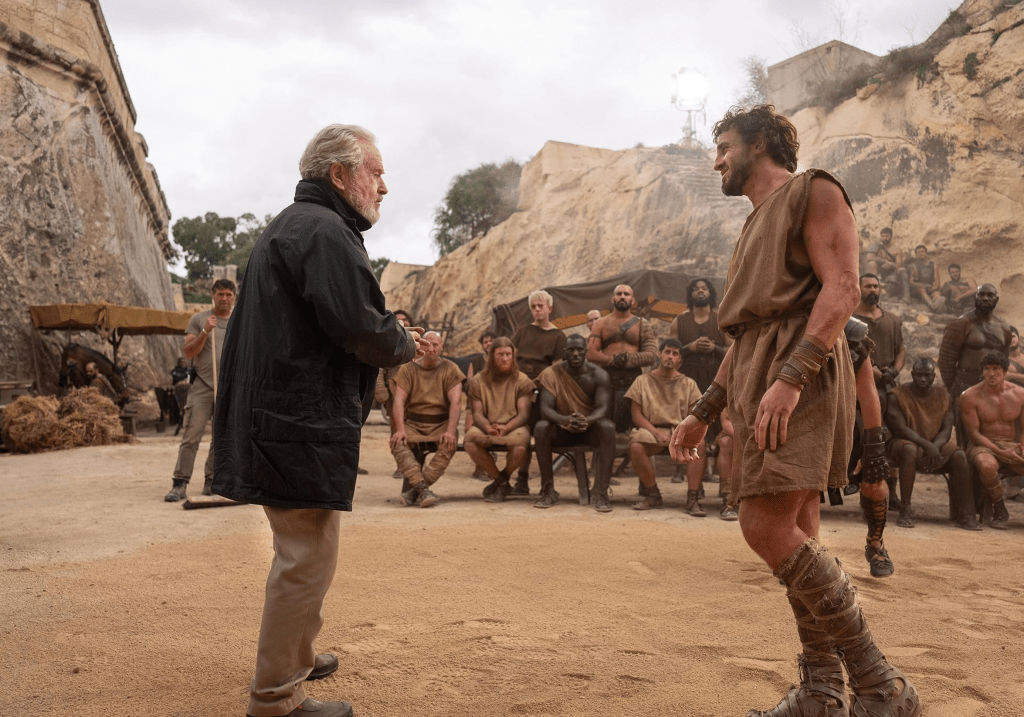
    Gladiator 2 (2024), Behind the Scenes | Dir. Ridley Scott

    On one side are Thrasymachus, Macrinus, Commodus, and the lunatic emperors; on the other, Marcus Aurelius, Maximus, Lucius, and their allies.

    Megalopolis depicts a future America modeled after the Roman Empire, drawing parallels between Rome’s power struggles, intrigues, and political campaigns, and the current U.S. political system as a form of critique. Set in New York City, the 85-year-old Coppola’s long-gestated film scrutinizes corrupt politics, flawed governance, a decaying society, and a life trajectory gone astray. Ridley Scott, a contemporary of Coppola, tackles the same themes in the same year, albeit from a different perspective but within a similar framework and motifs: a corrupt empire, scheming intrigues, an impoverished people, and a group of idealists resisting them. Thus, the ambiguity surrounding the antagonist seems to support the idea that Scott’s choice was deliberate. He signals that the core problem is not merely the leaders, as is often thought, but a philosophical structure represented by Thrasymachus and his ilk that persists to this day. On one side are Thrasymachus, Macrinus, Commodus, and the lunatic emperors; on the other, Marcus Aurelius, Maximus, Lucius, and their allies. Responsibility in the first film passed from Emperor Marcus Aurelius to his loyal commander Maximus; in this sequel, it shifts from Maximus to his son Lucius. Therefore, like Megalopolis with its more direct approach, Gladiator 2 goes beyond being just an action film, exploring the issues of modern society, politics, governance, and the concept of justice through the power struggles of the Roman Empire.

    Megalopolis (2024) | Dir. Francis Ford Coppola

    Gladiator 2 maintains continuity with its predecessor while deepening its arguments in this philosophical context. The film not only retells a story from the past but also, like Coppola’s Megalopolis, opens a debate about the meaning of concepts like power, justice, and virtue in the modern world. A massive-budget production that immerses its audience in the chaotic grandeur of gladiatorial combat, it raises the bar in technical and production aspects, delivering a stellar sequel. It honors and advances the legacy of its iconic predecessor and its central hero, Maximus Decimus Meridius, without tarnishing their memory. If only Hans Zimmer had taken charge of the music again! After all, the original film’s soundtrack still echoes in our ears. But let’s accept it as it is.

    Rating: 4 out of 5.

    Rating: 4/5


    External Links:

  • The Pale Blue Eye (2022) – English Review

    The Pale Blue Eye (2022) – English Review

    Scott Cooper (dir.) | Christian Bale, Harry Melling, Lucy Boynton, Gillian Anderson (acts.)

    Although I did not happen to watch any of their previous collaborations, Christian Bale and director Scott Cooper seem to get along very well as they insistently work together for the third time. The Pale Blue Eye is the seventh feature film of Cooper, who priorly made a mark with his 2015 movie Black Mass, in which Johnny Depp portrays FBI’s one of the most wanted crime bosses Whitey Bulger. Cooper also worked with Bale in Out of the Furnace in 2013 and Hostiles in 2017. This time Bale shows up as a producer also. The last point to make about the movie’s production is the acquisition by Netflix for 55 million dollars in March 2021 vis-à-vis other streaming services that also had made bids. As we can see, The Pale Blue Eye was already financially promising and contended for during its production. But what does it provide to its audience, and what do we encounter?

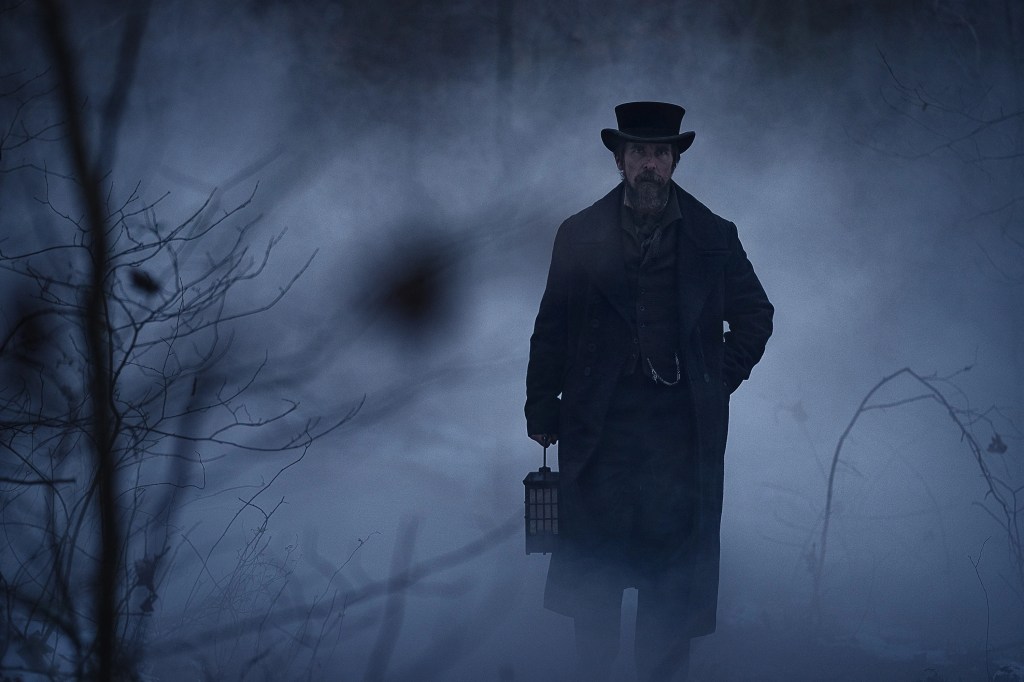
    The film is based on a 2003 Louis Bayard novel of the same name and is another detective movie as the recent popular release of Netflix, Glass Onion, is. One fascination with the film emerges from the inclusion of famous American writer and poet Edgar Allan Poe. Set in 1830 New York West Point, the movie is based on reputed detective Augustus Landor (Christian Bale) being assigned to investigate the murder of a US Military Academy cadet whose heart is violently carved out from his chest.

    Self-assured but alcoholic and retired detective, Landor, meets an intriguing cadet during his research: Edgar Allan Poe (Harry Melling), who is a cadet fond of literature and delved into philosophizing on life in a militarist setting with masculinity in the foreground. Almost a heretical in an environment built upon authority and hierarchy rather than freedom, which catches the eye of everyone in the story. As a matter of fact, Edgar Allan Poe steered himself to the army in 1827 due to the difficulties with financing his university education. Landor hires the fictional Poe without pay to collect information inside the academy while more violent murders with the same style succeed, fueling the fire. Yet, we suspect something is not right with Landor in the underlying theme as the actions carry over. Bale hints that Landor is having some troubles with his work and life with his lavishing performance, yet we remain puzzled. Hence, The Pale Blue Eye attempts to become richer and more layered than a mundane detective adventure. Melling’s moving performance as Poe also needs to be addressed in this regard.

    The Pale Blue Eye is not half bad in maintaining its plot twists while integrating interesting subjects like occultism and idiopathy as the duo of Landor & Poe proceeds with their investigation. However, it does not provide a sphere for the audience to connect with all ongoings. On the one side, Bale is trying to prove something more than a detective story is on play with his layered performance. Melling, on the other side, wants to reveal something special with the story, but the movie does not provide enough to convince its audience why they should pay attention to The Pale Blue Eye more than other genre samples. -Reminds me of Bale’s one of the other three appearances in 2022, Amsterdam. Bale (aside from John David Washington, Margot Robbie, and Robert De Niro) was part of the silver lining of that feature, which was hardly commendable otherwise.- Returning to The Pale Blue Eye, the movie is visually glamorous with its highly pleasing cinematography, and the story is attractive in actuality with the murders decorated, while is quite timid to say anything about its story right to the end. Hence, it is as difficult for the audience to bond with the characters and plot. The protagonist, Landor, remains superficial for most part of the movie despite Bale’s every intention to express something, which perhaps may be due to his additional production responsibility. The resolutions about individuals and society are late, making them inadequate to give meaning.

    In general, The Pale Blue Eye comes out as a modest movie while not offering a fortune to its audience other than its decent detective story arc and visual appeal.

    PS: It’s worth mentioning Robert Duvall’s cameo as a reason to watch.

    Rating: 2 out of 5.

    2/5

    My Letterboxd

    The web pages of The Pale Blue Eye:
    The Pale Blue Eye (2022) — IMDb
    The Pale Blue Eye (2022) — Letterboxd

  • The Menu (2022) – English Review

    The Menu (2022) – English Review

    Mark Mylod (dir.) | Ralph Fiennes, Anya Taylor-Joy, Nicolas Hoult (acts.)

    Spoiler alert

    The most unconventional menu in the history of gastronomy. The Menu is the 4th feature film directed by Mark Mylod, who is famed for a number of TV series even renowned among non-TV audiences, like Game of Thrones, Succession, and Shameless. The Menu begins with a highly affluent group of people voyaging to a private island to taste the food of Julian Slowik (Ralph Fiennes), one of the most exquisite chefs in the world.

    You start scenting the suspicion surrounding the setting while being exposed to the delicate menu specially crafted for this rich band. The menu is beyond merely tasting food or degustation, which the committed chef Slowik reveals with another protagonist: Margot Mills (Anya Taylor-Joy). Ms. Mills appears to find herself in this environment by accident, not only an inconvenience for the menu but also providing insights into Slowik’s personal story, from which we deduce that Chef is onto taking revenge from his past step by step with this extravagant menu. Pointing out a class division, he portrays the world by dividing it into givers and takers, and, thus, inviting Ms. Mills to his camp, givers, though granting no privilege. He is after retribution business with everyone on the island, from which he does not exempt himself. The narrative proceeds with sequences planned for every course that incrementally builds the monolithic story that covers what pulled Slowik to this venture, thanks to his exchange with Ms. Mills.

    It would not be wildly inaccurate to argue that Chef, who is excessively popular by the overwhelming demand, is undergoing alienation of labor, a Karl Marx theory. Alienated to his own labor, in other words, his very self, Chef finds these insatiable and selfish people responsible. He further directs the same alienation of labor criticism to his ‘clients,’ who are alienated to their own selves besides himself. Chef accuses them of being insincere, inhumane, and monsters. Yet, he does not only settle with them but also does include himself in this business. The ultimate goal of the night is to obliterate the alienation and break free from the shackles that fetter their real nature. To find their genuine selves and to liberate. And it is where the unlucky Ms. Mills’ rescue rests within, the only moment Slowik flashes back to his authentic self and recalls himself. Chef is resolute in sharing this ideal with his customers, serving his menu course by course.

    Established on class struggle and benefitting from Marx’s alienation of labor, The Menu bashes individuals and society, drawing attention to the degradation of humanity and the unnaturalness of selfishness. It levels at the violent and disordered individualism while being able not to spoil. The Menu delivers its audience a well-formulated experience, or namely a menu, to which the soundtrack suits befittingly. The film, with Ralph Fiennes performing iconically, can prospectively grow into a genre cult.

    Rating: 4 out of 5.

    4/5

    My Letterboxd

    Web pages of The Menu:
    The Menu (2022) – IMDb
    The Menu (2022) – Letterboxd